When you step onto the greens at Stoughton Acres Golf Course in Butler, Pennsylvania, you’re not just seeing healthy turf - you’re seeing a family legacy.
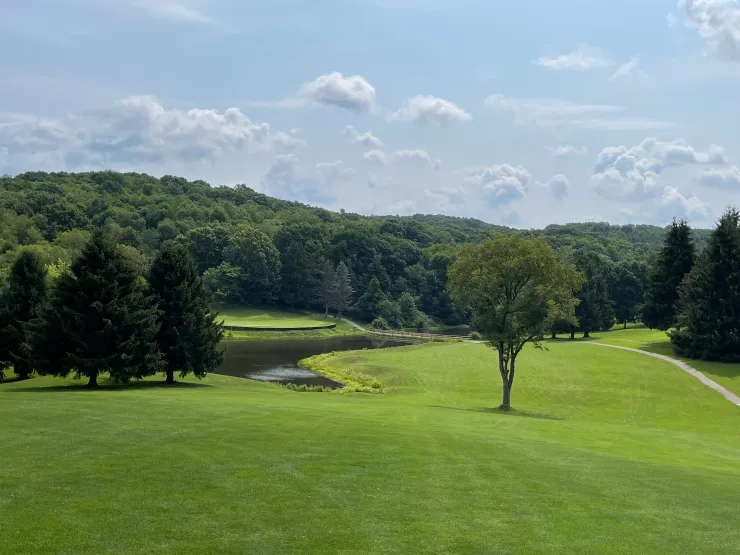
Stoughton Acres' signature hole #13
“Stoughton Acres Golf Course has been in business for 61 years,” says owner Sally Hangliter. “My parents were driving by my great grandfather's farm, and my dad said that property would make a great golf course. And so my dad turned the cattle farm into a golf course. That's where my sister and I grew up. I worked in the pro shop and then later when I was in College, I also did some mowing.”
After her father passed away five years ago, Sally returned to mowing—and quickly got more involved with course maintenance.
“I wanted to learn how to use all the equipment that we have. I worked an entire summer with that, and I got really interested in the course maintenance itself,” she says.
Sally’s mother was the driving force behind moving the course toward a turf management approach that incorporated biological products.
“My mom was very interested in health, and she had always been trying to get my father to use fewer pesticides. Anytime she came across alternatives to chemicals that he could be using on his greens, tees or fairways, she would share it with him.”
“I think he was very careful with what he used and he just used pretty much the conventional chemicals, because that's what his training had been. When my father died, my mother saw the opportunity to bring in products like yours. The two of us investigated our options and she kind of put me in charge… and that’s how we ended up finding your company.”
The first season with Soil Tech products wasn’t without resistance.
“The gentleman who was spraying for us, I think he was reluctant to change anything. I wonder if he sometimes chose to use products he was more familiar with because he trusted them. They had always done what my dad did—every two weeks, you put the pesticides down, the herbicides, the insecticides, and that's all they knew to do,” Sally said.
“From that first year we used Bio-Mega and Bac-Pack from Soil Tech, we have not had any major issues with our greens.”

Sally with sister & co-owner Debbie Loughry (left)
In 2023, Sally and her sister Debbie—who co-owns the course—hired Dan Blair as superintendent. He worked as an assistant superintendent at a nearby course, and upon arriving at Stoughton Acres, was more than a little doubtful about their approach.
“My old boss was completely against the use of biologicals, and so when I started here, I was going to make it my mission to get rid of your products and get them back on track. Since then, it's completely turned around: I'm trying to convince my old boss to use them.” Dan says.
It was after two extreme seasons that his perspective changed.
“Last year, we had record heat. We had no rain last year. Our greens did very, very well. And there were many local places that had issues,” Sally says.
“By the end of the year, Dan, our superintendent, was like, ‘Oh my gosh! I've never seen this!’ It weathered way better than where he had come from.”
The next year brought the opposite: the wettest season Dan could remember.
“I believe we're up over 20 inches above the average for this year, possibly more,” he says. “My old course was getting hammered… and they lost about 80% of #3 green, lost a number of collars. Over here? I was stressed for a week or two, and now I’m not even stressed anymore. It’s not even on my mind that we're going to get disease. We got Waitea patch early on, and Sally said that Bac-Pack is good for that. We sprayed it and it seemed like it took it right out. Other than that, we haven't had any disease all year on the greens.”
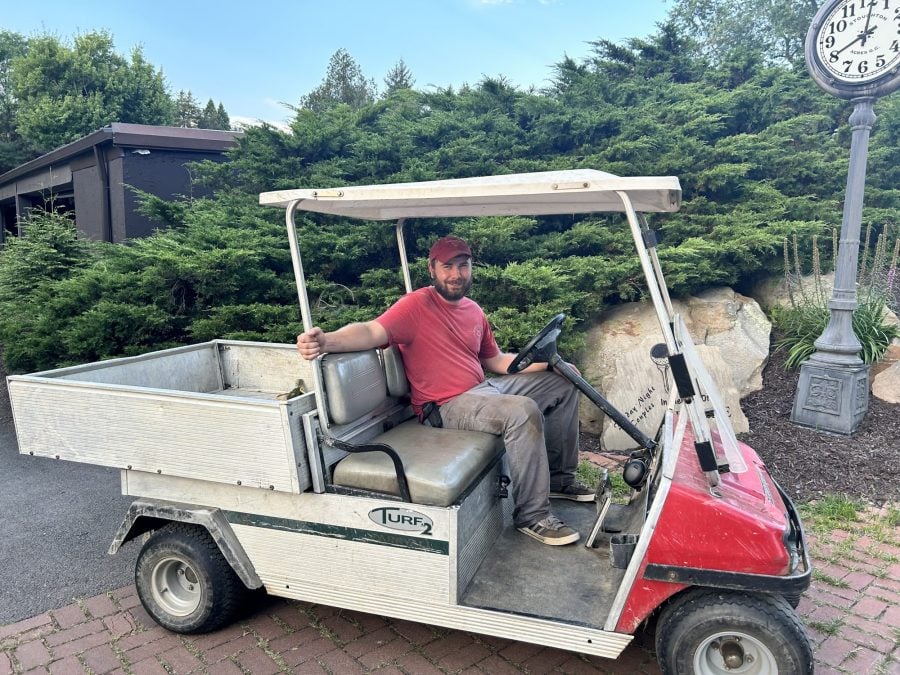
Superintendent Dan Blair
The turning point came during a stretch of 90-degree days and sopping wet conditions.
“I called you a few weeks ago… I was geared up to spray chemicals the next day,” Dan said. “I had everyone knocking on my door, salesmen, my old boss, not even people who sell to me advising me, I better get out there and spray preventatively, you know, expensive fungicides. Talking with you and Sally, we doubled up on your products, we jumped it ahead of the chemical spray, and then we sprayed the chemicals on Monday instead of that week. We cruised right through with no troubles.”
Today, both Sally and Dan credit their Soil Tech program with keeping their push-up greens strong through the most extreme Pennsylvania weather.
“We might have minor flare ups of some diseases, but we have not had any major issues at all with our greens in five years,” Sally said.
“Our greens… they look beautiful. We are known for our greens. I just had someone the other night say, ‘Your greens are better than any course around.’”
For Dan, the change has been eye-opening:
“There's got to be something to it. There's no way that we have the magic conditions time and time and time again to come out unscathed year after year after year. We just don't struggle with anything. These greens are like carefree pretty much, as long as you stay on the spray schedules.”
From drought to flood, Stoughton Acres hasn’t just survived—it’s thrived. And now, both Sally and Dan are committed to continuing the program that’s kept their greens healthy and resilient, and their stress levels low.
“Sally is Soil Tech’s number one fan,” Dan says. “There's not an ounce of doubt in her heart that it doesn’t work and that it's the right thing to do.”
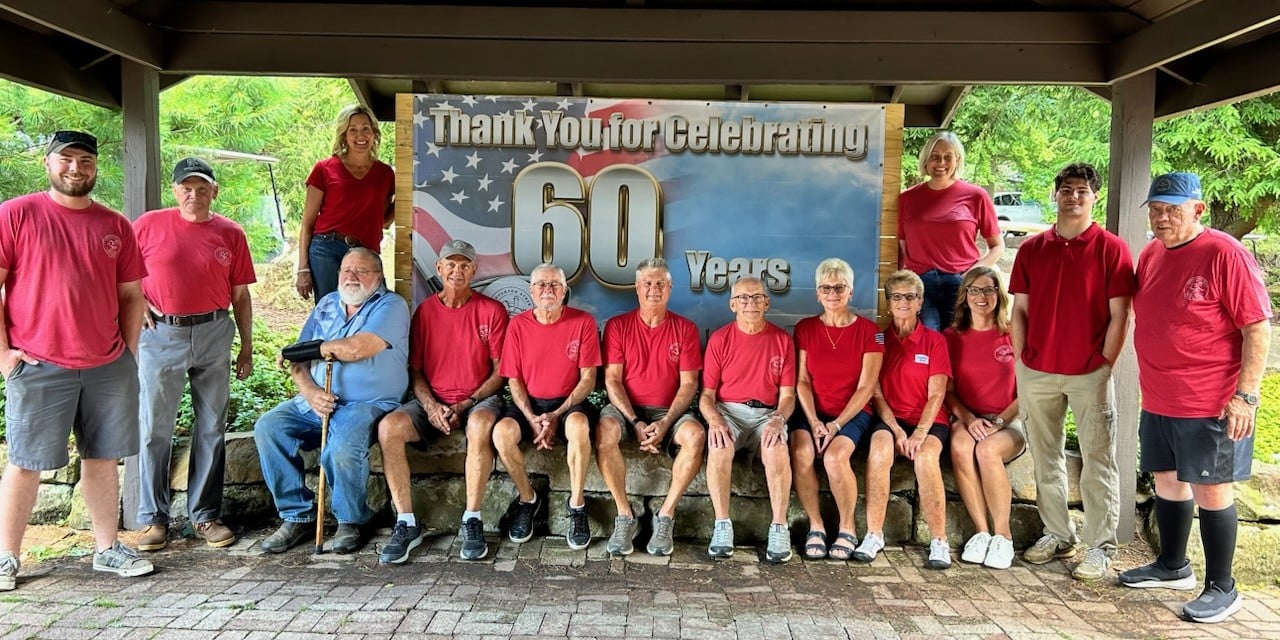
The Stoughton Acres team
Their experience shows that thoughtful incorporation of a biological program can help protect greens through even the most extreme conditions.
 Brian Hickey’s journey into golf course maintenance began with a simple desire to play free golf. "I guess I've always been a golfer, so I thought I'd work at a golf course. I started out actually on this golf course, picking range balls, parking carts, and washing carts. After a year of doing that, I switched over to the maintenance crew and found out that I really liked it.”
This newfound passion led him to further his education at Iowa State University, where he earned a degree in Turf Management. After gaining diverse experience across the country, including 13 years in Oregon, Hickey returned to Iowa to become the superintendent at Palmer Hills, where he has served for the past decade.
Upon his return, Hickey was tasked with enhancing the course's appeal to a broader range of players while maintaining its reputation as a challenging layout. "When I came here, they were looking for innovative ideas to increase how many rounds of golf they were doing. One of the things that my city administrator challenged me to do was to figure out how we could take this golf course and make it more playable for all skill levels."
To achieve this, Hickey implemented a series of strategic modifications aimed at improving playability without compromising the course's integrity. "We started creating additional forward tee boxes and we made the course more playable to a variety of people."
In addition to adding tee boxes, Hickey oversaw the removal of trees that overly narrowed fairways, strategic bunker renovations, and the introduction of The Forge, an innovative 18-hole putting course designed to engage families and promote community involvement.
Embracing Regenerative Turfgrass Management
Hickey's innovations extend beyond superficial changes. Inspired by industry leaders like Chris Tritabaugh at Hazeltine, Dan Dinelli at Northshore CC, and John Quinn in the UK, Hickey embraced a philosophy of regenerative turfgrass management. This approach reduces overreliance on chemicals, instead focusing on promoting overall soil health and ecology.
"Conventional turf grass management often includes very intensive cultural practices. We're a really busy golf course that does a lot of rounds. We don't have a Monday maintenance day or anything like that. It's always been a challenge to try to produce what the country clubs can create without having the extra time to put into the golf course."
To tackle these challenges, Hickey looked for alternative methods to produce high-quality surfaces without disrupting play. "Some of those cultural practices might be verticutting, sand top dressing and core aeration. I typically ask myself, “Are there other methods to be able to produce these high-quality surfaces without disrupting the surface for the golfers that are coming out to enjoy the course that day?””
Notable Results with Biological Products
Through careful experimentation with biological products like Thatch Relief and Bio-Mega, Hickey has achieved notable results, including improved drainage, reduced fungicide applications, and enhanced turf health. "It’s been a win-win for both golfers and the maintenance crew to be able to produce the type of playing conditions with fewer cultural practices."
"Products like Thatch Relief, that is organic, break down the thatch. That makes a lot of sense to me. How do we get there, though? We had to look at ways to reduce our fungicide usage because when I did the research, I found that fungicides kill all fungi, not just the bad fungi, but good and bad together. In a traditionally maintained golf green, you have a very low fungi-to-bacteria ratio, almost zero fungi because of the fungicides being used all the time. My goal was to get the good microorganism populations higher by using a product, Bio-Mega, that contains different fungi in its packaging, as well as good beneficial bacteria. Since making these changes, our fungi-to-bacteria ratio tested 1:1"
By utilizing products like Bio-Mega and Thatch Relief on a regular basis, Hickey has managed to reduce the thatch layer in the greens, which was previously restricting drainage. “We haven’t core aerified our greens in seven years,” Hickey shared. "At one point, we definitely had a thatch layer in our greens that was restricting drainage and that layer is completely gone now. The drainage is really, really good now, and we have push-up greens on most of the golf course. They used to footprint up all the time when golfers would go out there after rains, they don't do that anymore.”
Hickey has also seen a significant reduction in fungicide applications. "We started going with a few products from Soil Tech, so that we could incorporate them slowly into the budget. We observed no disease following a contact fungicide application for 21 – 28 days. This allowed us to save money on spray applications. When I first got here, we did 18 applications of fungicides for the first few seasons. We are now seeing that we're only having to put out about eight fungicides a year. That breaks down to three on fairways and five on greens. That's a significant reduction in fungicide use on our major turf playing surfaces."
Improved Fairway Drainage
 Hickey's sustainable practices extend to the fairways as well. "We use TurfTech Bio as a regular ingredient in our soils for our sprays on fairways. Typically, what we're spraying on fairways is a wetting agent and Primo for growth regulation, and then TurfTech Bio. Those are our main three things that we put in the tank. One of the biggest things I've noticed on our fairways is how they drain better."
These practices have led to reduced downtime after rain events. "We have a continuous cart path at Palmer Hills Golf Course, so we can make it cart path only and still get golfers out there right after rain events. Many times when I first came here, we were cart path only for three or four days in a row after a one inch or more rain event. Now we're back to the 90-degree rule after 24 hrs. I feel like the drainage of the golf course is much better. We haven't been spraying the rough, so we can tell exactly where we're spraying because we're draining better on the
fairways, and the only thing we've done differently is putting out the TurfTech Bio."
Reduction in Fertilizer and Labor Costs
Hickey's approach has also led to reductions in fertilizer and labor costs. "We've been able to reduce fertilizer usage as well. The microbes are much more proficient, and they're mineralizing the soil as well as micro and macronutrients. We've been able to cut back on our fertilization, which has allowed us to conserve resources. We've been able to cut back on the core aeration and the labor that's involved with that to redirect the resources to other parts of the golf course."
A Vision for the Future
Looking ahead, Hickey anticipates a broader shift towards more sustainable greenskeeping practices within the industry, driven by both environmental considerations and practical benefits. “I definitely see regulatory pressure coming... It's probably inevitable that it's coming this direction to the United States," he predicts. While acknowledging that completely eliminating chemical use might be challenging, Hickey is optimistic about the potential for a greater focus on soil health and the use of biological products to become standard in the industry. "I see this more natural greenskeeping being a huge part of the industry in the next five years... We're having better playing conditions all the time, and we're doing it in a way that's not hurting the soils."
Brian Hickey's journey from a young golf enthusiast to a pioneering superintendent embodies a commitment to innovation, sustainability, and a deep love for the game. Under his stewardship, Palmer Hills Golf Course stands as a testament to the transformative power of thoughtful, eco-conscious management in the world of golf.
“Soil Tech's program fits our mission statement pretty well. I mean, if you look at any mission statement, you're trying to do it cheaper and more responsible and more renewable and all those keywords. But I think we're actually doing it better than most, for sure,” says Jeff Hoste, superintendent of Village Greens Golf Course in Chicago, IL.
Jeff has been a Superintendent for over 20 years. He says “My GCSAA card says 30 so I was an assistant for seven years before that…”
When he first arrived at Village Greens, the general manager was interested in the idea of using biosolids. “He wanted us to put biosolids out everywhere, which we did for a while. Nasty job, and there's a smell associated with it but I was down with turning my brain onto something kind of new. After 20 years, you have to reinvent yourself a couple of times here and there otherwise you'll go crazy, right? It was just something to sink my brain into, obviously, personally and I believe in it. I think God had this figured out a long time ago, and we have, over the years, messed it up to the point where we need to fix it again.”
“So there's a kind of a push from the top to think about it or investigate it. I think it was always there as kind of a building block, but not as a tool, more of a garnishment, you know what I mean? Like a salt and pepper kind of thing in your spray, it wasn't the focus. It was certainly encouraged. So we did that and we brewed our own compost tea and we did a lot of other crazy things.”
Brewing your own compost tea, Jeff says “gets to the point where it’s difficult… But the problem is, in Chicago, it could rain in the middle of summer with very little notice or something would happen that it was spray day and I was ready to go and it's raining outside cats and dogs, so I had to dump it. And then it got to be a logistical problem. I was doing three tanks and it would throw things off to the point where it was a pain. And then I also got Gray leaf spot. That's when I decided that I'm not going to die on the sword for it. So I'm still going to try it, but I've got to throw some chemical out. It was just easier at that point. I knew what I would be getting.”
That’s when Jeff first heard about Bio-Mega and the idea of just using a single product. “There's so many variables that we ultimately just decided to go with you guys exclusively to see what would happen. It started off with Bio-Mega.”
After a full season, Jeff began applying Bac-Pack to his putting greens. “I was hooked because I wasn't seeing any disease anywhere, anytime. I would put Bio-Mega/Bac-Pack down monthly with a few other things. Nothing that would compete. That went on like eight months. I mean, went on all the way to August without having to spray anything. And that was before I knew about the Fungastop. That worked when we had leaf spot in the fairways. So I don't know. You just keep trying, you just keep playing with stuff. The microbiology is doing the work rather than what we would typically rely on. Again, you're not in the driver's seat, you're just trying to get everyone happy again soil-wise and then problems take care of themselves. That’s how it’s supposed to work at least, right?”
UPDATE: At the time of publishing, Jeff Hoste had been able to maintain Village Greens Golf Course with no conventional fungicides throughout the entire 2022 growing season.
 Nestled on the east bank of the Fox River in St. Charles, IL, Pottawatomie Golf Course is located in one of the most picturesque parts of the Greater Chicago area and is ranked as the 15th best 9-hole course in the US. Denise Gillet-Parchert has been the golf course superintendent at Pottawatomie for over twenty years.
Regarding how she ended up in the industry, Denise recalls, “I started at Joliet Junior College, and I was going to do floral design. One semester cured me of that! Florists knock themselves out every holiday. They work a million hours before every holiday. I thought, shoot, I don't want to do that. So I took the landscape turf track at Joliet Junior College, and I had to do on-the-job training the freshman year at Cog Hill. I started there just maintaining the flowers and the grounds around the clubhouse. They really liked me there, so they kept me on part-time in the wintertime when I went back to school. I then did my second on-the-job training there, but with the understanding that I did something other than what I did before. So they put me out on the golf course because landscape turf was the same track, the same classes, and I enjoyed it, I liked it and I stayed.”
After working at Cog Hill full-time for four years, Denise held positions at several other courses in the area, including at St. Charles Country Club and Rich Harvest Farms as assistant superintendent. In 1999, she was offered the superintendent's job at Pottawatomie and hasn’t looked back. “May 17th, I will have completed 24 years.”
 The location of the course is something that Denise takes very seriously. “We're Audubon sanctioned and we're right next to the river. We're pretty much in town, or just five blocks north of downtown St. Charles. In the back of your mind, every decision you make is, ‘How is this going to affect the environment? How is it going to affect the golfers? How is it going to affect you personally?’ We all want to live long, and you don't want to be using products that you're going to find out cause cancer ten years down the road.”
Denise continues, “I have tried organic (fertilizer), but if I were to put down organic fertilizer, there is a smell to that. You just can't get away from that, and you get complaints left and right about the smell and what you're putting down, and it sends red flags up for everybody. You try telling them that it's organic or it's all-natural products, and it's just a hard sell. So to use something that is quote, ‘good for the environment,’ it kind of came with a stigma of smell.”
Denise came across Soil Technologies’ product line three years ago and purchased enough Thatch Relief and Oasys Ultra to try on her fairways. “I'll be honest with you, the first time I got the products, I didn't use them. I used them the next spring, and things kind of looked pretty good. The way it's applied, because we're so busy at the golf course, from sunup to sundown, we apply it at night, we throw the water down. Nobody knows we've done it. And there's no odor, there's no nothing. And great results. So it's a win-win for everybody, and it's good for the environment.”
2022 saw the program extended to greens as well. "Last year was kind of an anomaly. I think everybody was able to cut back a little bit on their products, but I didn't have a problem with Dollar Spot at all this year (I did three apps on greens and two apps on fairways). And in years past, Dollar Spot was always like my nemesis, that I was constantly spraying for. I believe it's under control now. Whether it's thatch removal, I don't know, but sometimes you don't have to know. You just have to know it works. I don't know whether that's the right statement to make, but sometimes a visual is better than anything: results."
Independent lab testing of her greens revealed that organic matter content was reduced an average of 15.68%. On the feedback she was getting from the lab before using the products, Denise says, "Well, most of the time, the conversation revolved around the pH of the greens. And so it's been strongly suggested to core aerate two times a year. It just isn't possible for us. But the simple fact of the lowering of the organic matter just helps overall with the quality of the greens in the summertime. We have a sand green, four push up greens, one 1:1 mix green, a couple of 80:20 greens. So there's just a plethora of green material or different material for the greens. It's kind of hard to manage nine as one. The sand green we treat a little bit differently. But I found that by lowering the organic matter in the greens overall, it's going to help with irrigation and disease suppression, all of that."
With nearly four decades in the business, Denise shares some final thoughts, "I've been in the industry a long time, and I've worked for a lot of different superintendents or a few superintendents that had different ways of doing things. One superintendent told me, 'If it ain't broke, don't fix it.' And I think that's kind of your product. After seeing the results of your product, I might not know all the science behind it, but I can see the results, and the results are the important thing. If we can put more natural products down and use fewer chemicals, I think that's the trend of the industry, and the more we do that, the less we're going to be accused of poisoning the environment. I think we ought to use more of it. We're going to use more of it."
 What is our TurfTech Bio-Mega product all about? How does it work and how can golf course superintendents and other landscape professionals use it to enhance their turf performance? We hope this blog post will answer these questions and inform you about this revolutionary golf and turf product.
What is TurfTech Bio-Mega?
Steve Nichols, Exec. V.P. of Soil Technologies Corp. recently stated, "TurfTech Bio-Mega is a natural extension to our TurfTech branded products. Since 1986, TurfTech products have been trusted by turf managers world-wide to reduce soil compaction, inhibit turf diseases, and cut fertilizer requirements. Now, TurfTech Bio-Mega is available to turf managers who are seeking a total microbial ecosystem for transforming the rhizosphere and improving turf performance under all kinds of challenging conditions."
The TurfTech Bio-Mega formula is an enhancement of the original TurfTech formula that was developed in conjunction with Dr. Fred Williams at Iowa State University during the 1980's. The TurfTech product line was created to provide golf turf managers with an effective, broad-spectrum bio-inoculant used as an alternative to chemical inputs. Research at major turfgrass universities confirmed the efficacy of TurfTech. Data confirmed that TurfTech's nitrogen-fixing organisms could replace part of the fertilizer needed by fine turfs. In addition, research published by the E.P.A., showed that TurfTech was an effective method of reducing soil compaction. Finally, work done in the late 1990's confirmed that TurfTech could reduce the incidence and severity of fungal pathogens of turf.
What Makes TurfTech Bio-Mega Different?
This new TurfTech Bio-Mega formula adds a diverse concentration of beneficial microbials that are known to improve turf rooting, nutrient uptake, and plant health. In addition, Bio-Mega contains a variety of plant-derived substances including steroidal saponins. The impact of these phyto-chemicals, when combined with Bio-Mega’s microbial communities, is a genuine breakthrough based on solid soil science.
With the introduction of TurfTech Bio-Mega, Soil Tech Corp. offers the next evolution in the development of biologically derived products. TurfTech Bio-Mega promises to provide turf managers with an economically feasible method of reducing fertilizer, fungicides, and water requirements while achieving a greener, denser, more vigorous, disease-resistant turf.
How do you use TurfTech Bio-Mega?
Bio-Mega is easy to use! It is shipped as a dry powder. Simply mix the dry powder with 60-100 gallons of water per acre. Agitate the mixture thoroughly to keep the product in suspension for uniform spray coverage. Spray the mixture to the point of dripping on the target plant foliar surface. Water in (irrigate) after application. Spray with pressure at the nozzle greater than 25 lbs. p.s.i. Bio-Mega has the consistency of lime or talc and will pass a standard 60 mesh screen. Because Bio-Mega should not be mixed with chlorinated water, de-chlorinator is provided with each order.
What Can TurfTech Bio-Mega Do?
With TurfTech Bio-Mega you can expect many benefits including:
Check back at our blog frequently to learn more about TurfTech Bio-Mega and our other outstanding products!
 Our Customers Say it Best!
We love our products, of course we do! But when our customers love them so much that they take the time to tell us about it--well that’s something extra special.
One of our newest customer testimonials is from Matt Whalen. In a brief video Matt tells us about his experience with Soil Tech’s Bio-Mega. This breakthrough product combines a diverse concentration of beneficial microbials, steroidal saponins and other plant-derived substances to form a total microbial ecosystem.
TurfTech BioMega has increased the root mass on his greens, leading to some real results. His turf has survived everything from vandals to hydraulic leaks to heat. As Matt says, “There’s something going on in the soil and we’re reaping the benefits.”
Take a look here:
Bio-Mega Customer Review (link not working video unavailable)
Want more product info? Click here.
Questions or comments? Tell us all about it in the comments section.
 Mike Kitchen is a superintendent at Teton Pines Golf & Country Club which is near the Teton National Park and the Yellowstone Valley. He loves his job and the management team at Teton Pines, but like every job, his position does have its challenges.
A few years back, Mike was approached by a local environmental group called Friends of Fish Creek (FOFC). Fish Creek is a major tributary of the Snake River and runs through the Teton Pines Golf property. The FOFC mission is to enlist local stakeholders to adopt Best Management Practices (BMP) to help protect the Upper Snake River watershed by improving and restoring water quality in Fish Creek. In recent years there had been several instances of algae blooms and other indicators of excessive nutrient loads in the creek. “I began to think about things we could do differently here. As part of our initiative to try and reduce our fertilizer applications, I was contacted by Soil Tech’s rep Xavier Dupoux. As a rule, I’m not a snake oil guy, but what I heard from Xavier about Soil Tech’s experience over the past 30+ years, that got my attention,” says Mike. After discussing Soil Tech’s bio fertilizers, Bio-Min and Bio-Mega, with his assistant, they decided to do a trial in 2014.
“We did a test where we used Bio-Min on selected fairway areas with 30% less fertilizer, and compared it to areas that we fertilized as usual. We followed the recommended Bio-Min program during the season and at the end of the year, we couldn’t determine any difference in turf quality in the test plots,” Mike notes. As a result, Mike decided to use the Bio-Min program on all his fairway areas in 2015 & 2016.
“We’ve been very impressed with the results. We’re maintaining a quality stand of grass and we’re using 30% less fertilizer (21-0-24). In addition, we’ve noticed that areas where we had regularly had disease breakouts at the end of the summer just aren’t as bad as they had been. In 2016 it didn’t seem nearly as prevalent as previous years,” he observed.
“From a budgetary perspective, the savings in fertilizer is just about a break-even with the cost of the Bio-Min program,” declares Mike. “But, when you add in the environmental benefits and the suppression of diseases, then the Bio-Min program is a no-brainer for us here at Teton Pines. Being in the shadow of Teton National Park and near the Yellowstone Valley, we are under lots of environmental scrutiny. We are definitely benefitting from the use of Soil Tech’s bio-fertilizers and we will continue using the programs in the future. It’s the right thing to do,” Mike sums up.
 “I’ll never forget the day many years ago, when we were visited by a USGA representative from Florida. His comment was that, l’d never be able to grow grass on our 5th tee. It’s just too shady for Bermudagrass.”
When Richard McDanel, C.G.C.S. tells this story, he gives a little laugh. “The 5th tee is beautiful today. And we still have Bermudagrass and it only gets about 3 hours of sunlight a day.” After more than 25 years at Pine Lake Country Club in Charlotte N.C., Richard has seen and heard plenty.
Realizing that the 5th tee area would need some extra TLC, Richard decided to try out some mycorrhizal products to see how they could help the agronomic situation. “I started with granular fertilizers that had a little mycorrhizae in them but, I was never really sure if anything was happening. A lot of those products don’t specify the shelf-life of the mycorrhizae, and some others don’t even list what organisms are in the product and/or how many. Plus, I was never sure how long they’d been in the warehouse before they got to us here at Pine Lake.”
“When I heard about Soil Success from Soil Tech I liked that it was a sprayable material with a definite shelf-life and it has a very clear list of all the species and the concentration of each,” he continues. “When we started using Soil Success, we started seeing improvements right away, and it’s gotten better every year.”
Richard describes how he uses the product, “I only apply it once a year in the spring. I want to see everything moving before I spray it out. I mix it up in a slurry in a bucket first, and then take and spray it out. It’s the only thing that I do different on those areas, and it’s our biggest success on tees.”
As proof of that point, Richard describes his tees over last winter when the extreme cold had caused widespread damage in the area. “Our tees came through great…with no turf loss due to winter kill. I think the Soil Success is great stuff. I’d highly recommend it to other superintendents.”
 Jim Evans GCS, has groomed and maintained the 18 holes at Turnberry Golf Club in the Village of Lakewood IL for the past 30+ years. During his tenure, the course has played host to several USGA, CDGA and PGA events including the Illinois Open, and US Open Qualifying. Professionals and amateurs alike have commented on the condition of the course and its’ consistent greens.
Recently, Jim was interviewed by Xavier Dupoux, the USA National Golf Course Sales Manager for Soil Tech Corp. The following are Jim’s comments about Soil Techs’ biological product, Bac-Pack.
“I know that since we started using Bac-Pack on greens we’ve lowered the amount of fungicide we’re using. Last year, I think we did six apps of fungicides on greens for the whole year and we used to do 8 or 9 or 10. So it’s definitely reduced our fungicide usage, but we’ve also seen an improvement in the quality of the greens.
"When we had a nematode infestation, like 4 years ago, we started using Bac-Pack and within a month we started seeing the greens healing up. It started greening up and filling in all the areas. And then we started taking root samples to determine that the roots were regenerating. Before that we were getting roots where the nematodes were, at one inch. After the Bac-Pack apps we started seeing more root development. The greens just started healing up and filling in. It took all the stress off of them.
"Before the Bac-Pack apps we were doing wetting agents and hand-watering, anything we could do to try to get water into the greens and try to get them to heal up, and that wasn’t working! So, we used the Bac-Pack and they just started healing up. And for the last 4 years or 5 years, whenever we’ve used it, we’ve been doing it every 3 weeks and we haven’t seen any more problems with nematodes or severe thinning areas. It’s just healed up.
"I see the quality of turf is just so much better. The density is better, the overall health of the grass is just greener, healthier, thicker. The density has improved tremendously. The uniformity has improved. Golfers will say, “all these greens are the same….they all putt the same”. Because they’re so uniform, every green is just basically the same. They all look the same, they all putt the same.
"Golfers have noticed. The Chicago District Golf Assn. came out last week and rated the course and they noticed how uniform, they were all putting at 9.0-9.5 uniformly. It’s made managing these greens so much easier. Less input, less work, and just made it easier. It’s been a huge benefit for us.
"And disease control too. I think we’ve seen, before we started using this product, we we’re having trouble with anthracnose. In these areas that were thin, we were seeing a lot of anthracnose infections in the summer, we haven’t seen any of them in 4 years. We don’t treat for anthracnose any more. I don’t know what happened, where it went, but the turf is just healthier and maybe it’s just being able to fight it off more readily.
"Initially, we started doing it every 2 weeks at a pint per acre. And I think it took probably a good 4-5 weeks before we really started noticing how much better the greens started looking. The 16th green was always our worst green and it ended up being our best green. It just turned around within a month. We were trying to figure out why this was happening. We didn’t change anything else in the program other than Bac-Pack. I talked to my son one day, we were driving around, and I said I think this Bac-Pack is what’s providing us this quality turf. I didn’t have any other answer for it.”
"So, then we just continued to use it every year, we put it in the program with Bio-Mega and some wetting agents to try to get it to go down more readily. That seems to really helped get it into the soil more readily. It’s been easy to incorporate into our program, because we are going out every 2-3 weeks anyway. We just put it into the tank. That’s the primary thing we’re doing now: Bio-Mega, Bac-Pack, a wetting agent, and if we need a fungicide, we’ll put it in there, but if we don’t, we just leave it out. That’s why we’ve reduced our amount of fungicide apps over the years.
"It fit in with our budget, in fact it helped reduce our budget. As far as the amount of chemicals we’re using. To me it was a no-brainer. It’s providing some real benefits at a lower cost. That’s the way I look at it. It’s saving us money. We’re definitely saving $5000, maybe $10,000 in a year.”
 “I sprayed a tank-mix with Oasys Ultra and Thatch Relief and within about a week and a half, two weeks, I noticed a huge difference. It was like being on a different planet! The feel of the surface when you walked on it, to the receptivity of the shot, to the speed of the greens. The speeds went up probably 2 ½ to 3 ½ feet, we couldn’t even believe the response we got.”
- Chris Black, PGA pro and owner/operator at Hickory Grove Golf Course in Oelwein Iowa.
“I’m always looking for new ways to improve our turf and playing surfaces for our members and guests. We came across Liquid Aeration from Soil Tech and I thought, this could be a great program for us. One of the things that I dislike the most is aerifying. I think it hurts our revenue, members don’t like it, guests don’t like it, and certainly our staff doesn’t like it, it adds to our workload. It takes away time, money, things like that” says Chris.
Continuing, he states that, “These greens were built in 1967. They’re push-up style greens, native soil with a little bit of poa annua grass in there with mostly bentgrass. They just love this stuff! In a very practical sense, it would cost us $100-$200 per green just to aerify, clean it up and do all that extra work. The Liquid Aeration products that I put out cost about $160 worth of product (total for all the greens), and we didn’t have any of that extra work. It just makes economic sense. The members like it, our guests love it, it just really helped us a lot. I really appreciate these products.”
Describing the process, Chris continues, “What I did was, I applied the Oasys Ultra and the Thatch Relief and I kinda went outside the box with my application rate. I was very aggressive because I wanted to really get after it. Knowing that I probably wouldn’t hurt anything.”
One of the other key personnel at Hickory Grove Golf is Mike Lewis. Mike adds, “I’m the head golf coach at Upper Iowa University and I’m also a co-owner here at Hickory Grove. I’ve been the golf coach for about 9 years, been involved with this golf course for about 15 years now.”
Mike follows up on Chris’ comments, “After the application of the Liquid Aeration products, about a week and a half later, myself and my players saw an increase in green speeds which we had been looking for. To prepare our student-athletes for competition, such as going to famed golf courses like Cog Hill over in Chicago, we needed to get the greens speeds up. So that will help the players when they travel to other courses. Also, after the applications of the products, that thatch layer basically was gone. We’re seeing the ball react more like what we are used to (at other courses), which is a great thing to see for my players and for myself, playing wise.”
To wrap up, Chris offers the following, “I would like to strongly suggest that all the G.M.’s, P.G.A. professionals, and golf course superintendents, give this Liquid Aeration program a try. You will not be disappointed. It’s not a huge price, but you’ll save a ton. So good luck in your future, give it a shot.”
 Tom Rowell has been working in the golf course maintenance industry his entire career. Currently, he is in the Golf & Turf Division at Northeast Nursery. He reflects, “It’s amazing to think that one of the first biological products I ever came in contact with was over 30 years ago. At that time there weren’t many around, very few on the trade-show floor. Now, as time has gone on, biological products are part of our everyday use in the golf maintenance business,“ he states.
“I first met Steve Nichols and Soil Technologies in 1988 in Anaheim at the GCSAA Show. Steve had a booth there selling biological products and that caught my eye because it was advertising soil compaction relief. So I struck up a conversation with Steve, and after a couple years of researching their TurfTech product, I eventually purchased some product and started applying TurfTech on some compacted fairways, clay-based areas at the 18-hole golf club that I was working at. These were areas that would harden up like concrete in the summers.
"And, lo and behold, a few years later we were installing some yardage markers on these fairways and it occurred to us (my asst. and myself), as we were putting shovels in the ground and digging, that the soil was much more friable than other areas of the course where we hadn’t been using TurfTech and we could really see the benefits of the product,” Tom comments.
Then, as the research department at Soil Technologies kept looking into things, they began to employ bacteria for nitrogen-fixation and the new product became TurfTech II. From there, as the company worked with several universities, they brought out disease-suppressing microbiology that was incorporated into the product and TurfTech Bio was created.
Tom continues, “So, I was a superintendent up until 2000 and I really saw the benefits of the Soil Tech products we used on our golf course. When I went into product sales, I began offering Soil Tech products to my golf course customers. I have had some recent success supplying the Soil Tech products to courses looking to reduce their inputs of fertilizer and pesticides, fungicides, in particular. It can be done by using the Soil Tech products. They see very extensive root systems and drought-resistant turf,” Tom emphasizes.
Concluding, Tom states, “The thing that impresses me about Soil Technologies is just that they continue to research and expand the product line. The recent development of their Liquid Aeration program looks like it’s going to have a really nice place in the industry. It’s going to be able to help lawn care, golf, and everyone to streamline their processes. In this day and age with the lack of labor and help and how hard it is to do conventional aerification, if a product like this can help with relieving thatch and soil compaction and manage those situations it would certainly be a great help. And it seems like they have some great research and anecdotal evidence behind its effectiveness.”
 TurfTech Bio has been solving problems for 100’s of golf courses since 1985. This triple-action biofertilizer reduces soil compaction, cuts fertilizer needs, and suppresses turfgrass pathogens.
Andy Morris, GCS at the Country Club of Peoria in Illinois, has been using Soil Tech’s TurfTech Bio for the past 15 years. He wasn’t really looking to change the soil characteristics of their golf course. “Really, for us it was more about a healthier plant, trying to utilize some of the natural nitrogen in the soil system. Let the microbes do the work and break that down so that the plant can then take that and use it; develop a strong system below ground in order to produce a plant that’s really happy and healthy above ground. And TurfTech Bio works well with our strategies and formulas”, Andy said. “If you have a healthy microorganism population within the soil, then you’re going to have healthy soils and plants.”
The easy-to-use formulation consists of nitrogen-fixing cyanobacteria that restore the soils biological fertility, beneficial bacteria to inhibit fungal development, and polysaccharides that improve the crumb structure of the soil. “These polysaccharides form larger soil aggregates which appear to be beneficial to the soil,” claims Iowa State University microbiologist, Dr. Fred Williams. Dr. Williams’ research documented a structural change in soils treated with TurfTech Bio.
The CC of Peoria used to have bad dollar spot issues on their golf course, but Andy says they don’t see as much of that any longer. And they are not seeing some of the soil borne pathogen patch diseases and stressed turf they had seen in the past prior to using TurfTech Bio. “Our turf has done very well. It’s all parts of the pie that make the whole, but TurfTech Bio is definitely a part of that pie” said Andy. The CC of Peoria golf course has cut their nitrogen use and expense to almost half since adopting the TurfTech Bio program.
The TurfTech Bio product can be applied with ground spray rigs or through irrigation injection systems. Applied at 4-6 week intervals during the growing season, TurfTech Bio provides an economical way to build and maintain an ideal soil. It can be tank-mixed and worked into rotation with other products and combined with other inputs whether it’s a wetting agent, growth regulator or a compatible fungicide application.
Superintendents spray TurfTech Bio to produce fantastic fairways, terrific tees, and gorgeous greens. Andy concludes, “I enjoy the benefits of the TurfTech Bio on our golf course. It’s been a great product for us and Soil Tech is a great company to work with.”

Derek Rose (shown here with his dog, Izzy) is the GCS at Eagle Ranch Golf in Eagle, Colorado.
At the Golfdom Summit in 2015, Derek came across Soil Tech Corp. Xavier Dupoux was giving a speech about the products that Soil Tech has developed. Derek says that, “When he mentioned the Thatch Relief and the Oasys Ultra it really caught my eye and spurred my interest, you know, a way to help improve our tee boxes where we don’t have the man-hours to help properly maintain them health-wise, so I thought it would be a great idea to start using those products.”
"Derek continues, “So I started using Thatch Relief and Oasys Ultra just this year. I’ve seen probably a 50% increase in the firmness of our tee boxes, the moisture levels in our tee boxes have gone down…they’re not as spongy. Golfers have even noticed the tee box firmness has improved. So we’re going to continue that program through this year. We’ve done 2 applications already this spring. We’ll do another one this fall and we’re going to start doing the greens next year as well.”
"When Derek discusses his golf course, it’s clear that the lack of budget dollars has been a real challenge. “So, we have a lot of acreage out here we’ve got to take care of. The whole golf course is 150 acres, of which we maintain about 115 of those acres. We’ve got about 3.8 acres of greens, about 3.8 acres of tees, about 80 acres of fairways, so we’ve got a lot to maintain. And, we have a pretty small budget and we also have a pretty small crew, so when it comes to tee boxes we’ve definitely neglected top-dressing and aerification over the years, just because we haven’t had time to do it, can’t afford the sand, don’t have time for the man-hours to punch holes, remove thatch mechanically…. We have done that, but we’re not keeping up with it. I wanted to try and start to use something that would help, kind of biologically, in a sense, removing thatch and seeing if we could help improve the health of our tees that way.”

"Derek reflects on his tee boxes and says, “I would think if I were to try to maintain the tee boxes properly that would add up to $100,000-$200,000 a year extra on top of our budget. I’d imagine, at least, with labor and sand and all that other stuff.”
He concludes, “So, we’re going to try and do this program with Soil Tech products and improve the health of our tees by only spending a few thousand dollars instead.”
 Ever wonder what are typical PGA green-speeds? As recently as a decade ago, green speeds were about a whole Stimpmeter point slower than today. However, championship-level golf has become increasingly obsessed with chasing green speeds as agronomy continues to improve, enabling setup crews to pursue faster greens.
“Over the past few years, the demand for green speeds above and beyond the norm is on the golf course maintenance staffs agenda now more than ever before. The goal has been to increase ball roll without detriment to the turf,” says Phil Garside, Supt. of the 18-hole championship golf course at the Olde Hickory Golf & Country Club in Fort Myers, Fl. The course was designed by legendary Ron Garl.
The Maintenance Department for the Olde Hickory Golf Course has tried different silicate products to help strengthen cell structure inside the leaf tissue to help promote a more solid leaf blade. The chelated products have helped to produce a more upright growth habit on their “TifEagle” greens leading to a better cut from their mowers and less resistance to the golf ball. Hence, improved green speeds.
After testing a variety of different products, they have found that Soil Tech’s liquid product, KCS 2-0-14 applied to greens @2 gal/acre with Primo @4 oz/acre every two weeks gives them their desired results.
Phil says that throughout their high season, October to May, they increased their height of cut to .150 and still maintained speeds between 11.25 and 12 on the Stimpmeter. “No big flushes in growth, a nice color, tight dense upright plant and an improved root system. In conjunction with other cultural practices, Soil Tech’s KCS 2-0-14 “is a must for golf green health, playability and golfer satisfaction” says Phil.
 Meet Darin Douglas, Supt of the Mt. Prospect Golf Club in Mt Prospect, IL.
The golf course was originally built in the 1920s, so it had all original greens and soil. The soil in the fairways was pretty much the soil that was there. So, they just stockpiled all the topsoil and spread it back out. There were areas where the soil was good and not so good.
In June 2014 the Mt Prospect Golf Club closed for renovations for a little over a year. The golf course went through a full renovation. The holes were all newly routed, with complete USGA greens replacing the old soil pushup greens. Golfweek Magazine says that Mt. Prospect Golf Club is one of the top 15 “best courses you can play in Illinois.”

Darin first heard about Soil Tech products from his predecessor Fred Behnke, CGCS. While Darin was assistant supt., he remembers Fred calling the TurfTech Bio product “pixie dust.” “Fred would always say: go spray that pixie dust. He believed in the product and I just kept on the program ever since and really saw good results from it” said Darin.
Right after the renovation Darin noticed there was standing water on some fairways and he noted that he hadn’t used TurfTech Bio that year. The following season he started applying the product again. “Using TurfTech Bio through the grow-in really helped the germination and the process move forward nicely. The rest of the grass caught up—like the slower germinating maturing turf caught up with the rest after I got back on the program. All those wet spots pretty much disappeared,” says Darin.
As far as saving money, Darin said “TurfTech Bio definitely saves us money in fairway fertilizing. I basically don’t use any granular fertilizer on the fairways.” Other than some fertilizer he puts on through the irrigation system (that he does periodically), all of his fairway fertilizing comes from Soil Tech’s TurfTech Bio. “So it’s saving me quite a bit of money not having to spread fertilizer throughout the season. For the acreage with tees and fairways it’s probably saving at least $9000/$10000 a year. The $3000 investment for Turf Tech Bio—you get a good return for the product.”
 "Green" is a word commonly used in the turf industry. In the case of Steve Nichols, V.P. of Soil Tech Corp. and John Carlone, CGCS at Meadow Brook Club on Long Island NY, Nichols says, “When I first met John in 1986, we were both pretty green. I was in my first year of golf course sales, and John was in his first year as superintendent at Middle Bay CC. Somehow we’ve continued the relationship and remained friends over the past 32 years.”
Nichols continues, “When I first met John Carlone, he was a young guy open to the idea of a new product to improve the sandy soils on his golf course. TurfTech Bio was the product that Soil Tech was introducing to the golf course market at that time and even though all of our research (up to that point) had focused on agricultural soils, John was still motivated to try the product and document the results on his golf course.”
According to John, “From the first time Steve spoke with me regarding TurfTech, it sounded like a valuable product for use on golf course turf. After learning more about it, I decided to try it for two main reasons: (1) To get better moisture retention in the rootzone of the sandy soils that existed at my golf courses. (2) To try to replace expensive wetting agents.”
Carlone decided to test the product on 2 acres of fairway turf and to compare the treated areas to adjacent untreated areas. In this way he felt that he would have the test results to prove the product. Over the 42-day duration of the test (June 24-August 5) he observed, “Before treatment, these fairways were regularly irrigated from 20-25 minutes. After the treatments with Turftech, I was able to reduce irrigation time to 10 to 15 minutes per sprinkler. Also, the turf in the untreated check plots did not seem as dense as the treated turf.”
Based on these initial results, Carlone took the next step. “In order to study the effects of TurfTech further, I treated all 21 acres of fairway turf on Sept 20. While this was not optimum growing season, 5 weeks after application of TurfTech, the divots in the treated areas were more filled with grass blades than the untreated areas,” he reported in a letter.
Nichols comments, “In the letter that John Carlone wrote to me on December 9, 1986 he documents his test results and concludes with, Thank you for introducing me to this fine product.” And, that was the beginning of a 32-year connection.
From that point forward, Soil Tech followed John’s advice to get some university research done on the product. John remembers that, “You not only did it then, but continue to have your products tested now. I think that is an important aspect of your company that separates you from other ‘Bio’ companies. Maybe that's why Soil Tech has been around longer than most ‘Bio’ companies.”
Nichols says, “Over the years I always had an affinity for John and his kind support for a young sales rep and his new product. When I would see him at shows or at his new golf course (Meadow Brook Club) we always shared turf stories, kept up on family, and talked about the latest and greatest in turf research on bio-products.”
More recently, during the GIS 2018 in San Antonio, Carlone came to visit the Soil Tech booth on the trade show floor. Within minutes of his arrival, John was helping Steve Nichols introduce the Soil Tech brand to other superintendents and sharing his perspective. Steve comments,” It’s just how John is. Helpful, friendly, and knowledgeable. It’s been a great bond over the years. We are both still very excited about our careers and our industry and the growth we’ve been part of.”
These two ‘green’ young guys are still enjoying their lives and careers, even though their ‘greenness’ has been replaced by some ‘greyness.’ “It’s been a great journey, says Nichols, “and I’m glad that John Carlone has been part of it.”
 Joe Ettawageshik is Golf Course Supt. at LochenHeath Golf Course in Traverse City, Michigan. Joe started as a second assistant 10 years ago and then, two years ago, became Director of Grounds and Maintenance. Over the past decade, Joe observed how his bosses used different fertilizer and chemical regimes. When he became superintendent, he started to develop his own strategies, which included being open to trying new products.
A few years ago, Joe decided to do a trial run with Soil Tech’s Bio-Mega product. “The Bio-Mega product was a pretty unique one as far as the organic nature of it,” Joe said, “[but] my philosophy revolves around minimal inputs to get maximum outputs, so I was looking to try to reduce chemical and fertilizer applications and still get the same results.” Joe was hoping Bio-Mega would help him do that.
Joe initially tried Bio-Mega on LochenHeath’s new, 5-acre practice facility. He incorporated Bio-Mega into his normal fertilizer and chemical program. Over a two-year period, he started to wean off some of the other inputs and still saw great results.
In the 2nd year of this trial, the fungicide that they normally use was accidently left out of the spray tank (twice). That meant two months of no fungicides in the middle of the summer!

In the areas treated with Bio-Mega, the turf was still fine and they did not see any disease. Though he hadn’t planned to omit the fungicides, Joe could see that the Bio-Mega was helping because he did see disease in areas of the golf course that were not treated with Bio-Mega.
For Joe, it’s about having LochenHeath Golf Course be the best product possible. He believes that being preventative and treating the soil is extremely important. “Treating the soil is where the plant starts and where it comes from. That’s where it needs to be healthy. So, having that treated there only makes the grass healthier and prevents disease outbreaks.”
All in all, Joe is happy he decided to experiment with Bio-Mega. He says, “Bio-Mega is very simple and easy to use. It mixes up very well with every product. So no compatibility issues. No extra time. It was very easy to add to our program.”
“After seeing an ad for the Liquid Aeration program, and then reading a few testimonials, my interest grew in the products. A lot of golf is crammed into our short seasons here in Wyoming, so anything we can do to stay ahead is a bonus. After 3 years on the program, I am sold and especially after 2020,” says Superintendent John Roth, GCS at Paradise Valley Golf Center in Casper, Wyoming.
He goes on to explain what it was that sold him on the Soil Tech program, “Upon starting this program I felt our greens were in good shape so a noticeable difference was not obvious right away. What was obvious was the condition of the greens the following spring. The wind in Wyoming during the winter is utterly ruthless so desiccation is always my biggest concern (much more than any winter fungus even when we average 80” of snow). Since we only topdress heavy with no covers, we have to keep an eye on them and keep the water flowing.”
“When the temperatures started upward, I was very pleased to see that all the greens were without any issues, therefore good playing conditions were achieved much earlier,” states John.
He goes on to explain how Liquid Aeration helped him during the 2020 golf season, “This past year we were scheduled to replace our irrigation controllers. With the material on-site and then the COVID-19 virus starting to cause problems, we decided against bringing in a contractor and to do the work ourselves. The extremely dry weather put the job into a critical phase as we didn’t want to be without water for too long. With the virus came an unbelievable amount of golfers which caused a huge delay when trying to identify sprinklers in between groups of players. Every day the crew asked me if there was another tournament and every day I said NO, just jobless golf fanatics. Since they were on the worst irrigation schedule possible, I fully expected to have some issues with the greens, but honestly, even with all they were facing, the low humidity and high temps, sporadic watering and heavy traffic, the greens were fine. I don’t plan on undertaking another project like that in the middle of the summer, but I now know that these greens with Thatch Relief and Oasys Ultra can handle a lot of stress.”
And, according to John, there are many other advantages. “Throughout the summers in the past we have had our fair share of LDS and extra attention was always needed. The past two years we have not had those issues and especially this year with no rainfall from April to mid-September I felt that the Thatch Relief was doing its job.”
When asked about the ease of usage with the products, he says, “We spray on a normal basis every two weeks and to integrate this program into the existing routine was not even a consideration. It is a reasonably priced program, but when we can eliminate hand watering and a couple needle-tines throughout the summer its cost effectiveness becomes even greater. Also, I have always been a fan of organics so to try another product is just normal business.”
Lastly, John concludes, “Due to the fact that the summers in Wyoming are quite short most years, and then very unpredictable the next, we do not always complete our list of projects…..aerification being one of them. Pulling plugs in the snow or waiting for the ground to thaw seems to be a common occurrence. With the small window to get our work done, comes an even smaller level of golfer patience. Anything we can do to keep the course playable is truly our biggest goal. Liquid Aeration is a plus in that regard.”
